



Reading time: 8–10 minutes | Author: Engr. Younus Usman
What Is DPC and Why Does It Matter?
Damp Proof Course (DPC) is a continuous barrier built into a wall or floor system to stop moisture from traveling where it should not. Without an effective DPC, structures are exposed to capillary rise (ground moisture wicking upward), lateral moisture (rain splash, wet soil), and condensation-driven damp patches. The visible symptoms—flaking paint, powdery salts (efflorescence), musty odor, and blistered plaster—are only the beginning. Over time, dampness degrades finishes, invites mold, damages built-ins, and increases maintenance costs.
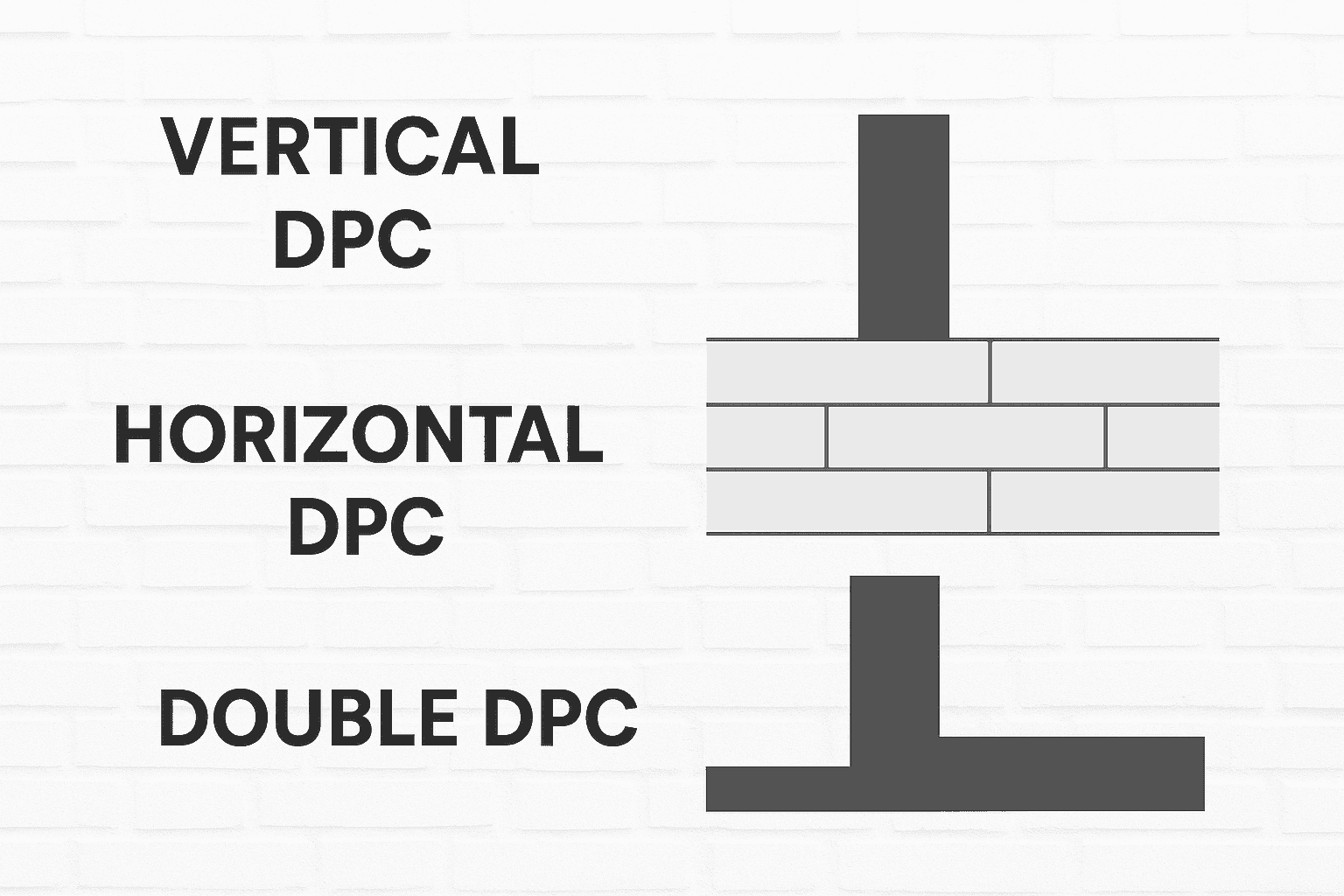
In most residential builds, three terms come up repeatedly: Horizontal DPC, Vertical DPC, and Double DPC. They address different moisture paths. Get the placement and continuity right, and you break the moisture chain; get them wrong, and repairs will be expensive and persistent.
Horizontal DPC: The Capillary Cut-Off
Horizontal DPC is an in-plane barrier laid within the wall—typically just above ground or at the plinth level—to stop ground moisture from rising by capillary action. Think of it as a “moisture firewall” inside the wall assembly.
Where It Goes
- All external walls at or just above plinth level (commonly the first or second course above finished ground).
- Internal load-bearing walls that spring from ground-bearing foundations or slabs.
- Thresholds and wall-floor junctions where capillary bridging often occurs.
Typical Materials
- Bituminous or polymer-modified membranes (approx. 3–4 mm).
- HDPE/EPDM sheets designed for damp proofing.
- Rich mortar or concrete bands with approved waterproofing admixtures.
- Liquid-applied damp proof coatings (two or more coats, protected by a screed or a brick course).
Execution Tips
- Lay on a clean, level, dry substrate to avoid punctures and dips.
- Lap sheet joints by at least ~100 mm; roll firmly to remove air and ensure bonding.
- Reinforce corners and changes in direction; weak spots often begin there.
- Protect before masonry resumes—use a thin protection screed or mortar leveling layer.
When a horizontal DPC is missing or discontinuous, you’ll often see damp marks starting low on the wall and climbing over time. Salts appear because moisture dissolves mineral content and deposits it as the wall dries. The cure is rarely cosmetic; you need to restore a continuous capillary break.
Vertical DPC: The Lateral Moisture Shield
Vertical DPC is a barrier applied to the face of a wall (externally or internally) to resist moisture arriving from the side—wind-driven rain, garden sprinklers, wet backfill, or splash zones. Where horizontal DPC breaks capillary rise, vertical DPC resists lateral ingress.
Where It’s Most Useful
- Basement and retaining walls where soil sits directly against the wall.
- Plinth walls and splash zones exposed to heavy rain or frequent washing.
- Parapet walls and terrace upstands that hold water or catch wind-blown rain.
- Transitions—where different materials meet (e.g., concrete to masonry) and cracks tend to form.
Common Systems
- Liquid-applied waterproofing (acrylic, polyurethane, or bituminous) in multiple coats applied cross-directionally to minimize pinholes.
- Self-adhesive or torch-applied membranes on primed substrates, terminated neatly with a bar or counter-flashing at the top.
- Fillet coves (small mortar chamfers) at wall-slab junctions to ease membrane bending and prevent sharp-corner failures.
Vertical DPC is often skipped on simple builds, but in wet or exposed locations it is the difference between a dry wall and a recurring damp patch. Combine it with robust drainage (weep holes, perimeter drains, proper grading) to reduce hydrostatic pressure against the wall.
Double DPC: Comprehensive Protection Where It Matters
Double DPC means combining a horizontal DPC with a vertical DPC so that moisture is blocked from both directions—below and from the side. It can also mean reinforcing a particularly sensitive detail with two layers or systems to create redundancy.
When to Specify It
- Basements and below-grade spaces with wet soil or a high water table.
- Sites where external ground level is higher than the internal floor level.
- Parapets and roof upstands that see frequent ponding or splash.
- Planters or water features built adjacent to habitable walls.
How to Tie It Together
- Install the horizontal DPC at plinth level and turn it up 100–150 mm on the wall face.
- Lap the vertical membrane over that turn-up to create a continuous moisture envelope.
- Terminate upper edges with a bar or sealant; protect external membranes with boards or screeds before backfilling.
Yes, double detailing costs a bit more up front, but it is usually cheaper than chasing damp into finishes and furniture later. On high-risk plots, treat it as an insurance policy for dry interiors.
Materials, Thickness, and Quality Control
- Membranes: APP/SBS bituminous or synthetic sheets (often 3–4 mm). Follow the manufacturer’s lap and heating/adhesion guidance.
- Sheets (HDPE/EPDM): Check puncture resistance and UV stability. On vertical faces, add a protection board before backfill or render.
- Rigid Bands: Where mortar/concrete bands are used, add a tested waterproofing admixture at the recommended dosage.
- Liquid Coatings: Build up to the specified dry film thickness (DFT). Two or three coats in alternating directions are common.
- Joints and Corners: Minimum ~100 mm laps; add patches at corners, pipe penetrations, and terminations.
Quality control is simple but non-negotiable: clean substrate, correct overlaps, continuous coverage, protected surfaces, and documented inspections before covering up. If you cannot see it later, photograph it now.
Typical Mistakes (and How to Avoid Them)
- Wrong level: Placing the horizontal DPC too low or too high disrupts the capillary break. Keep it at the designed plinth level and continuous across wall lines.
- Broken continuity: Gaps at door thresholds, corners, and column-wall junctions are common failure points. Reinforce and overlap generously.
- Poor surface prep: Dust, moisture, and protrusions puncture membranes. Prime and level before application.
- No protection: Fresh membranes damaged by masonry activity. Add a protection screed/board first.
- Ignored penetrations: Pipes and conduits need collars, boots, or patches; sealant only is rarely enough.
- Mixed materials, no bridge: At concrete-to-masonry transitions, use fillets and bridging tapes to accommodate movement.
Climate-Aware Best Practice
Design DPC with your local climate and site conditions in mind:
- Wind-driven rain or frequent washing: add vertical protection on splash zones and exposed façades.
- High water table or wet soils: treat below-grade walls with vertical membranes and specify double DPC at plinth junctions.
- Roof terraces and parapets: cap the top, coat the face, and shape drip edges so water sheds away from the wall.
- Drainage matters: control surface water, ensure correct grading, and consider perimeter drains to reduce water pressure on walls.
Quick Selection Guide
- Primarily capillary rise risk: Horizontal DPC is essential.
- Lateral moisture risk (rain/backfill): Add Vertical DPC.
- High-risk zones (basements, raised external ground): Choose Double DPC.
Costs vs. Long-Term Value
A well-executed DPC adds a modest percentage to early construction costs but pays back by preventing chronic damp, repaint cycles, spoiled plaster, swollen carpentry, and mold remediation. Especially on sensitive plots, the premium for double detailing is outweighed by the avoided repairs and reputational risk.
Frequently Asked Questions
Q: Can a thick screed replace a proper DPC?
A: Not reliably. Unless it is a designed, tested damp-proof system with correct admixtures and terminations, screed alone will not stop capillary rise.
Q: We found a break in the DPC after construction. What now?
A: Expose the joint, install a lapped patch or liquid bridge, and re-protect. For widespread failures, a retrofit cream injection may be considered, but it is a compromise versus doing it right at the start.
Q: Do we need Vertical DPC on every facade?
A: Not always. Use it strategically where exposure and moisture risk are high—basements, splash zones, parapets, and windward faces.
Summary and Recommendation
Horizontal DPC stops capillary rise within the wall; Vertical DPC shields the wall face from lateral moisture; Double DPC combines both for high-risk interfaces. Focus on continuity, correct placement, robust materials, and protection before covering up the work. If your site is exposed, below grade, or frequently wet, plan for Double DPC at design stage rather than troubleshooting dampness after handover.
Prepared by Land Guru — practical construction guidance for homeowners, builders, and site teams.
